Orff & Kodaly-- Hand Signs & Stick Notation

HOME
STAFFWRITER
MORE INFO
OUR NEW FONT-- SingASign!
ORFF & KODALY
CREATIVE IDEAS
FREE DOWNLOADS
OUR CUSTOMERS
WORD 2004+
OTHER QUESTIONS
TECH TIPS
HOW TO ORDER
SingASign© 
TrueType Music Font
an exciting new tool for Orff and Kodaly teachers!     
 
If you've always wanted an easy way to make
sol-fa sightsinging visuals for your classes,
 this is it!
SingASign includes both diatonic and chromatic hand signs.
Also in the font are quick-to-type stick notation groups.  
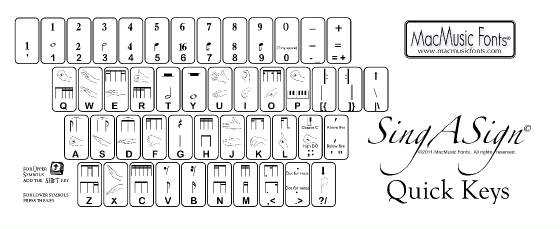
Plus, you get a new C to C keyboard.
(StaffWriter's keyboard was F to F.) 


SingASign's design has the diatonic scale degrees (which get the most use)
under the  Home Key  positions.  You don't even have to move your hands!
 
SingASign/SASqkDRM.jpeg
 
   Do         Re         Mi          Fa                                     So         La          Ti           Do  
 
 
Rhythm entry is quick and easy! 
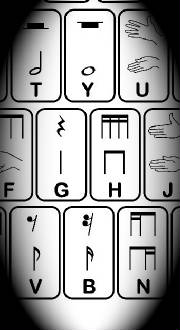
The stick notation is grouped by beats, not single notes.
Special feature:   The most frequently-used note values 
(quarter, half, whole, 2-8th and 4-16th notes) 
are typed with the index fingers!  
Two fingers-- now, how easy is that?
    
 
SingASign/SASqkrhy.jpeg
 
Think of all the great-looking visuals you can make,  
and think of all the money you can save by making your own! 

      SingASignQuickKeys.jpeg
To purchase SingASign, click HOW TO ORDER.


IMPORTANT NOTES ABOUT CHROMATIC HAND SIGNS
 
There are many variations of chromatic hand signs.
Because they were not included as part of the original 
diatonic set, teachers have more or less developed their own. 
After research and consideration, we chose chromatics that seem to be
the most widely used and the easiest for children to make with their hand.
For teachers who use two hands (one hand pointing down next to the diatonic hand sign)
we decided on a "down arrow" to represent the second hand.  The arrow
should be typed right before the diatonic which is to be lowered.